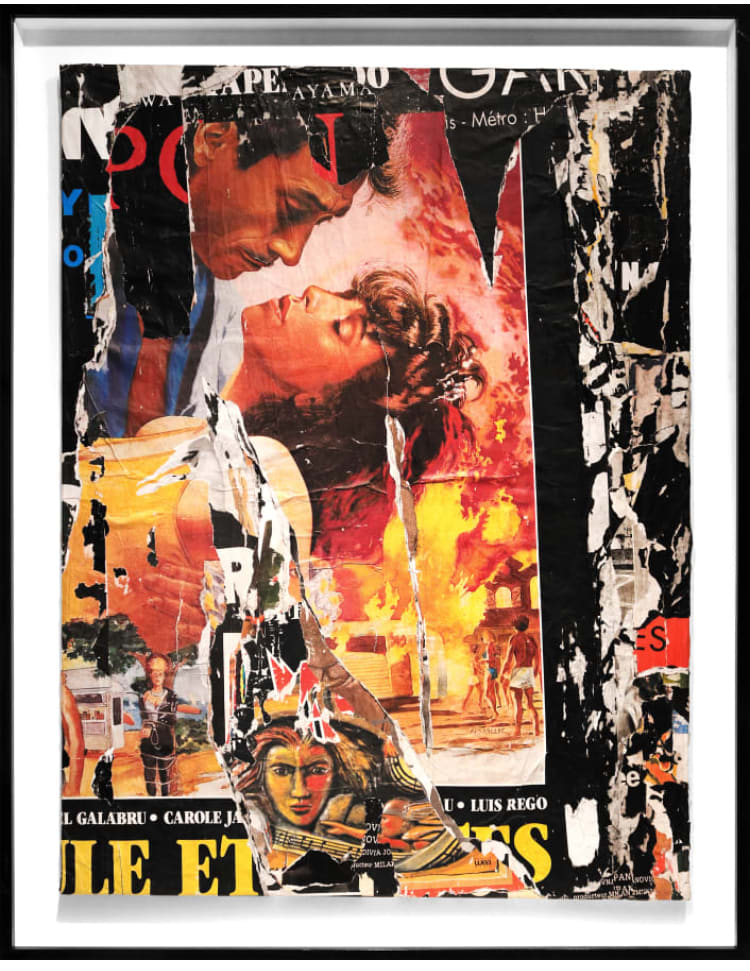
Jacques Villeglé (1926-2022) was an important French artist who is considered a central figure of New Realism and Ultraletterism. He began his artistic career while studying painting and architecture in Rennes, where he initially created sculptures from found objects such as steel and wire collected on the Atlantic coast. Dissatisfied with his academic training, he followed his student friend Raymond Hains to Paris in 1949. Together they developed the technique of tearing off posters, which became known as „affiches lacérées“ and characterised Villeglé's work for decades. Their first joint work „Ach Alma Manetro“ marked the beginning of a new aesthetic of appropriation.
Villeglé sought his inspiration directly in the urban environment. He removed thick layers of posters from the walls of cities and reworked them by tearing off the top sheets to reveal fragmentary motifs and shadowy lettering underneath. He described these compositions as „the world newspaper of the street“, as for him they captured the visual language and cultural context of the respective society. This process of regulating advertising space by passers-by and companies who wanted to make room for new advertising was refined by him as a form of artistic expression.
Today, Villeglé is recognised as an important precursor of Pop Art. His works, which document everyday life in the second half of the 20th century, can be found in renowned international collections such as the MoMA in New York and the Centre Pompidou in Paris. Until his death in Paris in June 2022, he remained an advocate of the idea that art lies hidden in the collective process of the street and is constantly created anew through the interaction of the public with its surroundings.